"Breakthrough in Quantum Computing Achieved by European Scientists"
Breakthrough in Quantum Computing Achieved by European Scientists
European scientists have announced a groundbreaking advancement in quantum computing, marking a significant step forward in the race toward ultra-powerful, next-generation computation. A research team led by physicists at a leading European institute has successfully demonstrated the stable operation of a quantum processor with more than 100 qubits—surpassing previous records and paving the way for practical quantum advantage in real-world applications.
Quantum computers operate on the principles of quantum mechanics, where qubits—quantum bits—can exist in multiple states simultaneously. This allows quantum systems to perform complex calculations at speeds that would be impossible for classical computers. However, maintaining the stability of qubits has been a major challenge due to their extreme sensitivity to environmental noise, which causes errors and short coherence times.
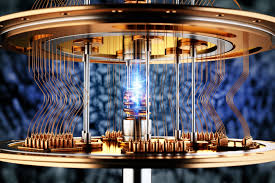
In this latest breakthrough, the researchers employed a new form of error-correction code and a unique cryogenic environment that kept the system at temperatures near absolute zero. These innovations drastically reduced quantum decoherence, extending the duration that qubits can maintain their quantum state. By successfully running stable quantum operations over a prolonged period, the team demonstrated the feasibility of scaling quantum systems without exponential error rates—a vital step toward practical quantum computing.
The researchers also introduced a modular design that allows additional qubits to be integrated without compromising performance. This architecture could support rapid scalability, bringing us closer to quantum machines that outperform classical supercomputers in solving problems such as molecular modeling, cryptography, and optimization tasks.
European Union research programs and international collaborations provided essential funding and infrastructure support, emphasizing the importance of global cooperation in advancing quantum technologies. The team's findings have been peer-reviewed and published in a top-tier scientific journal, drawing attention from tech companies and government agencies alike.
Experts in the field are calling this achievement one of the most promising developments in quantum technology to date. While full-scale quantum computers are still years away from widespread use, this milestone represents a solid leap toward realizing that vision. With ongoing investments and research, quantum computing is poised to revolutionize fields ranging from medicine and logistics to cybersecurity and artificial intelligence.
This European-led advancement underlines the continent’s growing role in quantum innovation and sets the stage for the next chapter in computing history.